Diamond Polishing Pads: The Complete Buying Guide
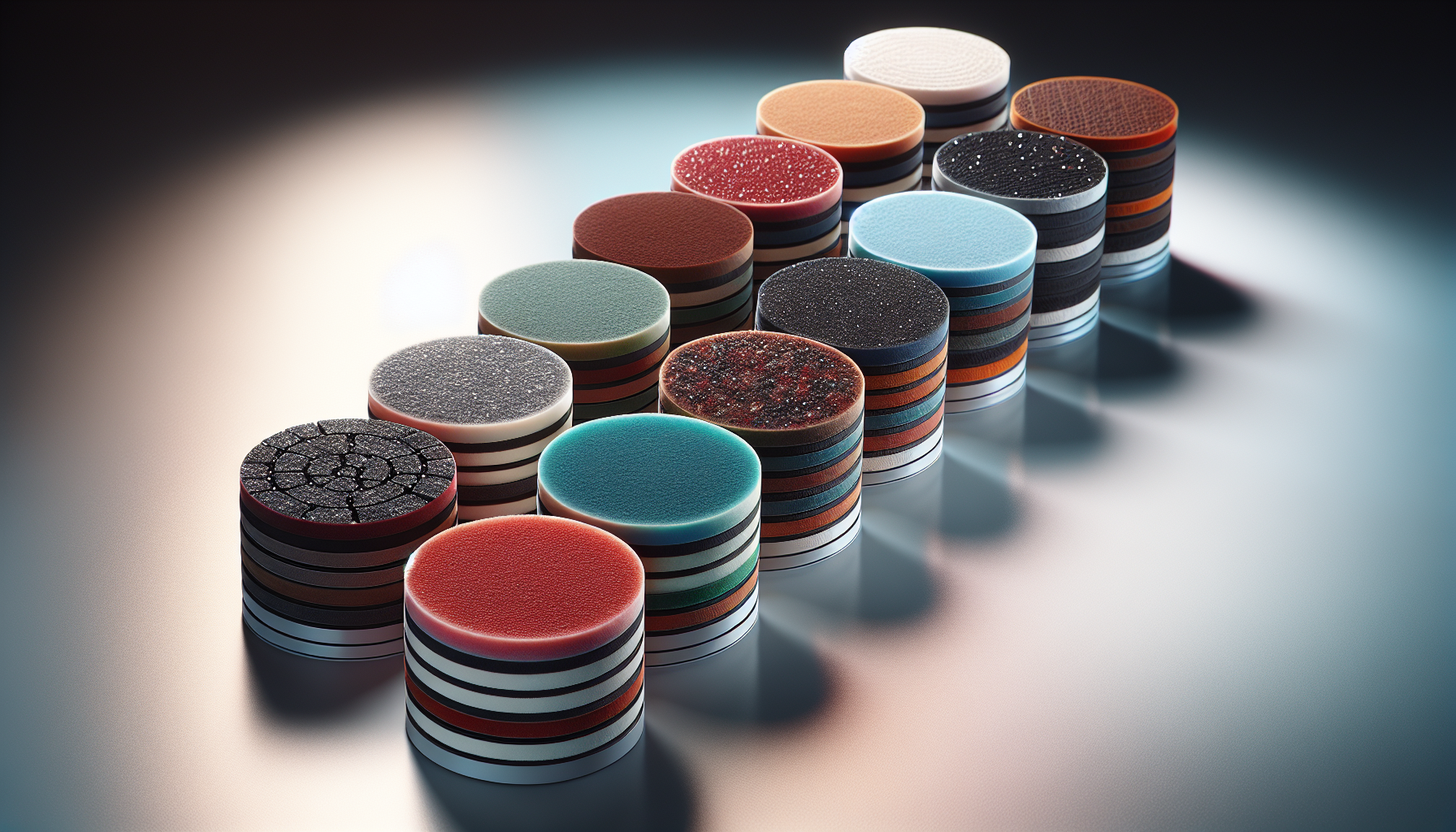
Diamond polishing pads are how you take raw concrete from rough to refined. This polishing pad buying guide covers wet vs. dry polishing, grit progressions, resin bond vs. metal bond, pad sizes and backing types, and how to match pads to your equipment and project.
How Concrete Polishing Works
Concrete polishing is a multi-step process using progressively finer diamond abrasives to grind and refine the surface. You start with coarse grit to remove imperfections, then work through finer grits until the scratches are too small to see — creating the polished appearance. The process starts with metal-bond tooling (heavy grinding) and transitions to resin-bond pads (polishing). A chemical densifier is usually applied partway through.
Metal Bond vs. Resin Bond
Metal Bond Diamonds
Diamonds in a metal matrix — same principle as diamond blades and grinding cup wheels. Used for initial grinding: leveling floors, exposing aggregate, removing deep scratches. Grits typically 16 to 150. These are grinding tools, not polishing pads.
Resin Bond Diamonds
Diamonds in a resin (plastic) matrix. Softer and more flexible, producing a finer finish. Resin bond pads create the actual polish — taking the surface from hazy to shiny. Grits typically 50 to 3,000+. When people say “diamond polishing pads,” they usually mean resin bond.
Grit Progressions for This Polishing Pad Buying Guide
- 50 grit — Very coarse. First resin bond step, removes metal-bond scratch patterns.
- 100 grit — Coarse. Surface starts to look cleaner but isn’t shiny yet.
- 200 grit — Medium. Often where densifier is applied.
- 400 grit — Medium-fine. Noticeable sheen. Stopping point for many commercial floors (satin finish).
- 800 grit — Fine. Clear, reflective sheen.
- 1,500 grit — Very fine. High-gloss finish.
- 3,000 grit — Ultra-fine. Mirror-like finish for showrooms and high-end residential.
You cannot skip grits. Each step removes the scratch pattern of the previous step. Skipping from 100 to 400 leaves visible scratches that the finer grit can’t remove efficiently. For a detailed walkthrough, see Concrete Polishing Grit Progression Guide.
Wet vs. Dry Polishing
Wet Polishing
Water as coolant and lubricant. Keeps pads cool, reduces friction, washes away swarf, eliminates dust. Generally produces a better finish. Standard for countertops. Downside: slurry management.
Dry Polishing
Dominant method for floors — eliminates slurry, allows faster work. Pads are formulated for the extra heat. Dust managed by vacuum systems on the grinder.
Important: Wet and dry pads are not always interchangeable. Check the rating before use.
Pad Sizes and Backing
- 3” pads — Standard for hand polishing, countertops, edges, detail work. Hook-and-loop (Velcro) backing.
- 4” pads — Slightly larger, also for hand polishing. Some users prefer the larger coverage.
- Floor pads — Various formats matched to planetary grinder brands (HTC EZ Change, Husqvarna Redi Lock, etc.).
Equipment
Angle grinder with backer pad — Simplest setup for countertops and small areas. Use variable-speed — you need RPM control.
Dedicated polisher — More control than a grinder. Available from Flex, Metabo, Alpha.
Planetary floor grinder — Essential for large floor areas. Multiple spinning heads from HTC, Husqvarna, Lavina, Diamatic.
Where Densifiers Fit In
Chemical densifiers (lithium silicate, sodium silicate, or potassium silicate) are applied during the polishing process — typically between the 200 and 400 grit steps. The densifier penetrates the concrete’s pores and reacts chemically to form calcium silicate hydrate, which hardens and densifies the surface. This makes the concrete harder, less porous, and easier to polish to a high gloss.
Lithium silicate densifiers are the current industry standard because they don’t leave residue, penetrate more evenly, and work on a wider range of concrete types.
Common Mistakes
Skipping grits — the most common mistake. Each grit must fully refine the previous step’s scratches. Skipping leaves visible marks.
Wrong pad type for wet/dry — wet pads overheat when used dry. Dry pads may not perform well wet.
Not using densifier — without densifier, the concrete stays soft and porous, making it harder to achieve a high gloss.
Going too fast — rushing through grits or covering too much area per pass leaves inconsistent results.
For product picks, see Best Polishing Pads for Concrete and Best Polishing Pads for Granite. For the full step-by-step process, see How to Polish Concrete Floors.
Recommended Polishing Pads
Virginia Abrasives manufactures diamond polishing pads — check the VA Amazon store for current availability and pad sets. For diamond blades and grinding tools to use alongside your polishing work, browse the full VA lineup.
Frequently Asked Questions
What grit sequence do I use for polishing concrete? ▼
A typical sequence is 50, 100, 200, 400, 800, 1500, 3000 grit. Each step removes scratches from the previous grit. Skipping grits creates visible scratches in the final finish.
What's the difference between wet and dry polishing pads? ▼
Wet pads use water for cooling and dust suppression — they produce a higher-quality finish and last longer. Dry pads are used where water can't be managed, like occupied spaces or upper floors.
How many square feet can one set of polishing pads cover? ▼
A quality set of resin-bond polishing pads covers 500-2,000+ square feet depending on the concrete hardness and the grit level. Lower grits wear faster than higher grits.
Related Guides
- Best Grinding Cup Wheels for Concrete— Best diamond grinding cup wheels for concrete leveling, coating removal, and sur…
- Grinding Cup Wheels: The Complete Buying Guide— Diamond grinding cup wheel buying guide. Segment patterns, bond types, and how t…
Shop Virginia Abrasives on Amazon
Diamond blades, cut-off wheels, and grinding tools. U.S. manufactured. Free Prime shipping.
Browse Products →