Silica Dust Safety for Concrete Cutting Pros
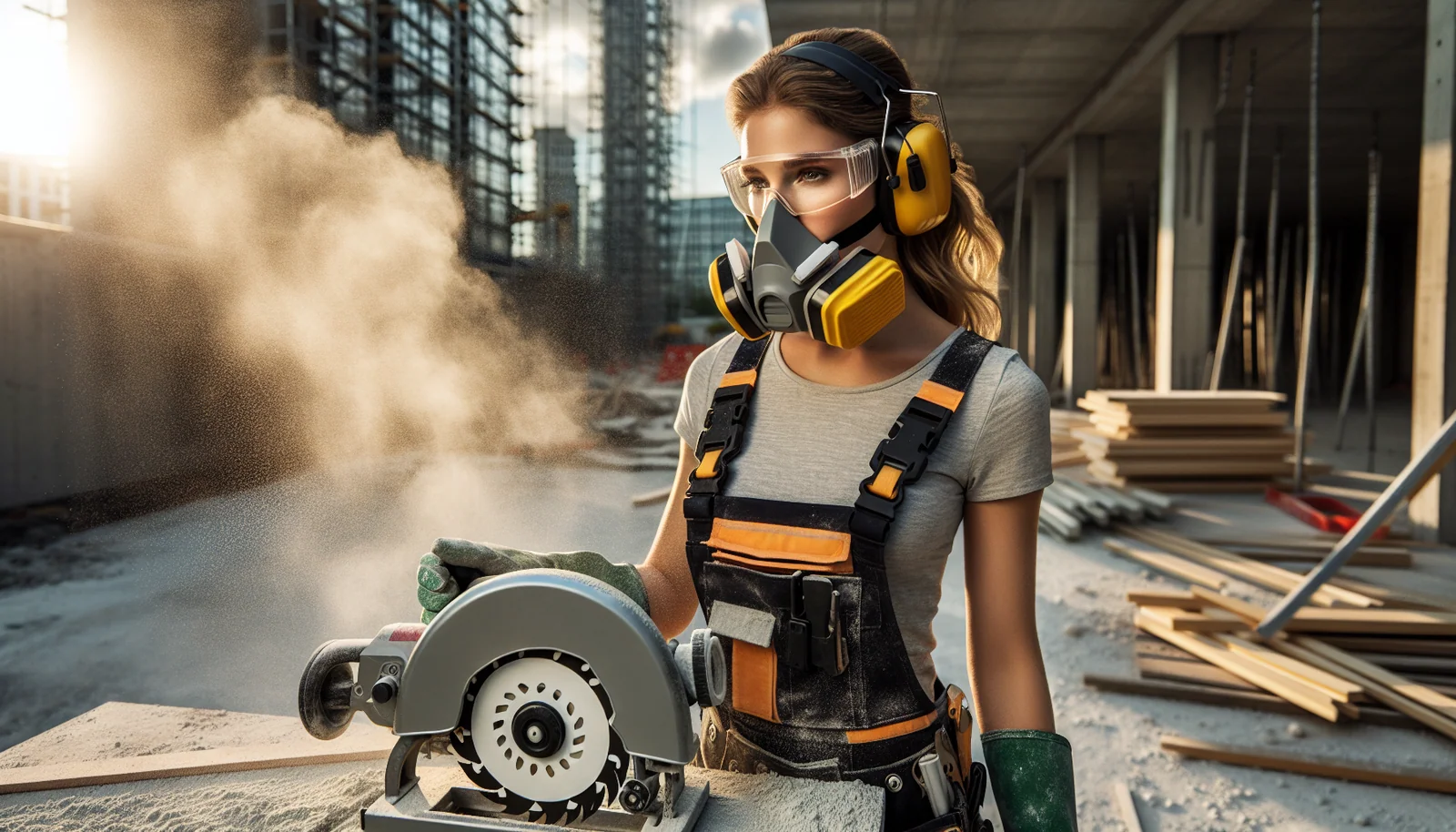
Table of Contents
- What Silicosis Actually Looks Like
- What Is Crystalline Silica?
- OSHA Silica Standard (29 CFR 1926.1153)
- Table 1 Compliance
- What Inspectors Actually Check
- Dust Control Methods
- Wet Cutting
- Vacuum Shrouds and Dust Extractors
- Ventilation
- Respirator Selection for Silica Dust Safety
- Where Your N95 Actually Fails
- Indoor Cutting: The Contamination You Don’t See
- State-by-State: Where Enforcement Bites
- Silica Dust Safety by Task Type
- Medical Surveillance
- The Bottom Line on Silica Dust Safety
- Safety Equipment
- Recommended Safety Equipment
Respirable crystalline silica is the most serious occupational health hazard in concrete cutting. Every cut through concrete, block, brick, or stone releases microscopic silica particles that, when inhaled over time, cause silicosis, a permanent, irreversible lung disease with no cure. This silica dust safety guide covers OSHA requirements, dust control methods, respirator selection, and protection strategies by task type.
What Silicosis Actually Looks Like
The reason this matters isn’t a fine. It’s what silicosis does to you. You can cut concrete dry without controls for years and feel nothing. The damage accumulates in the lungs as fibrotic scar tissue, silica particles your immune system can’t break down. Symptoms typically start 10-30 years after exposure begins.
- First sign, age 35-45 (if exposure started in your 20s): shortness of breath climbing stairs you used to climb fine. Persistent dry cough. You think you’re out of shape.
- Mid-stage, 5-10 years later: can’t carry a 5-gallon bucket of mortar up a flight without stopping. Doctor finds reduced lung function on a routine physical. CT scan shows nodules.
- Late stage: supplemental oxygen for normal activity. Increased risk of TB, lung cancer, and autoimmune disease. There is no treatment that reverses the damage. Lung transplant is the only option for end-stage silicosis and the wait list is long.
Acute silicosis (massive short-term exposure, months of unprotected dry cutting in enclosed spaces) can develop in 1-3 years and is fatal in 5. NIOSH has tracked it in countertop fabricators cutting engineered stone, in tunnel workers, and in concrete cutters working unventilated indoor jobs.
This is the section your future self wants you to read at 30. Wear the respirator.
What Is Crystalline Silica?
Crystalline silica (primarily quartz) is a mineral found in concrete, mortar, brick, block, sandstone, granite, and virtually all masonry materials. When these materials are cut, ground, drilled, or crushed, fine silica particles become airborne. Particles smaller than 10 microns are “respirable”: they penetrate deep into the lungs and cause damage that accumulates over years of exposure.
OSHA Silica Standard (29 CFR 1926.1153)
OSHA’s construction silica rule sets the permissible exposure limit (PEL) at 50 micrograms per cubic meter of air, averaged over an 8-hour shift. This is an extremely low limit, invisible to the naked eye. The rule requires employers to either follow Table 1 (simplified compliance) or conduct air monitoring to demonstrate exposure is below the PEL.
Table 1 Compliance
Table 1 is the most common compliance path. It lists specific construction tasks and the required dust controls for each. If you follow Table 1 for your task, you’re presumed compliant without needing air monitoring.
The respirator column depends on where you are working, and that is the part people get wrong. Table 1 does not give one answer per tool. For most entries it gives one answer outdoors and a different one indoors or in an enclosed area, and for several entries the answer also changes past four hours of work in a shift. Read your task’s row for your conditions rather than memorising a single figure.
| Task | Engineering control | Respirator, outdoors | Respirator, indoors or enclosed |
|---|---|---|---|
| Handheld cut-off saw | Continuous water to the blade | None at 4 hr or less; APF 10 over 4 hr | APF 10 |
| Walk-behind saw | Continuous water to the blade | None | APF 10 |
| Handheld grinder, mortar removal | Shroud plus dust collector: 25 cfm per inch of wheel, 99% filter, cyclonic pre-separator or filter cleaning | APF 10 at 4 hr or less; APF 25 over 4 hr | APF 10 at 4 hr or less; APF 25 over 4 hr |
| Handheld grinder, other than mortar | Shroud plus the same dust collector, or water (outdoors only) | None | None at 4 hr or less; APF 10 over 4 hr |
| Handheld drill | Shroud plus dust collector at the tool maker’s airflow, 99% filter, filter cleaning; HEPA vacuum to clean holes | None | None |
One more thing the table does not show: a handheld grinder fitted with a cutting blade is not a “grinder” for Table 1 purposes. OSHA’s letter of interpretation of July 25, 2019 says that when the manufacturer permits a cutting blade on the tool, OSHA treats it as a handheld power saw, so the water row applies, not the shroud-and-extractor row. A dry grinder cut with a vacuum shroud is an engineering control under the alternative exposure control method, which requires an exposure assessment; it is not Table 1 compliance.
Two of those rows catch crews out regularly. A walk-behind saw cutting outdoors with water needs no respirator, and the same saw doing the same cut inside a building needs one. And a handheld cut-off saw crosses into respirator territory on hours alone, even outdoors, once the operator passes four hours in the shift.
This table is a summary written for planning, not a substitute for the standard. Read the row that matches your task in 29 CFR 1926.1153 Table 1 before you rely on it, because the wording of your specific entry governs.
What Inspectors Actually Check
Reading the Table 1 paragraph above tells you the rule. Knowing what an OSHA compliance officer will look for in 30 seconds on your jobsite is different.
- Water actually reaching the blade. Not dribbling on the saw deck. Not pooled on the slab. Reaching the kerf. The inspector will look at the cut for slurry: wet kerf = water working. Dust + dry kerf = citation regardless of how full your water tank is.
- The dust collector’s filter is rated. Where Table 1 allows dust collection, the collector needs a filter of 99% or greater efficiency and a filter-cleaning mechanism, and a HEPA filter clears that bar. A shop vac with a paper filter labeled “HEPA-style” carries no rating you can show an inspector. Bags are the consumable side of the same setup. See the OSHA Table 1 HEPA vacuum bag guide and replacement bags by vacuum brand.
- The vacuum shroud actually seals to the tool. Table 1 calls for a commercially available shroud, operated per the manufacturer’s instructions. A shroud zip-tied onto an angle grinder does not meet that.
- Respirators are fit-tested and documented. Per 29 CFR 1910.134, every employee wearing a respirator must be fit-tested annually with documented results. A box of N95s on the truck without fit-test records is a citation.
- Written exposure control plan. OSHA requires a written silica exposure control plan for every covered workplace. Most one-truck contractors don’t have one. The template is free from OSHA. Go download it.
- Medical surveillance records. For each employee required to wear a respirator under the silica rule for 30 or more days a year, the employer must offer (and document offering) medical surveillance at no cost, including a chest X-ray, a lung function test and a work history. No paperwork = citation.
The base fines for serious silica violations run $16,000+ per violation under current OSHA penalty schedules (verify the current figure, penalties adjust for inflation annually). Willful or repeat violations multiply quickly. Most one-truck contractors who get audited get cited on multiple line items, and the total commonly exceeds the cost of the equipment that would have made them compliant.
Dust Control Methods
Wet Cutting
Water suppression is the most effective dust control method. Water captures silica particles at the source, turning dust into slurry. For walk-behind saws, tile saws, and handheld cut-off saws with water kits, wet cutting is the standard approach. Water flow should create a visible stream on both sides of the blade.
The slurry handoff. Wet cutting moves the silica problem from your lungs to your wastewater stream, but the slurry it produces is itself regulated. Fresh cement slurry runs pH 12-13 (about as alkaline as oven cleaner) and is a prohibited non-stormwater discharge under EPA’s NPDES Construction General Permit. You cannot legally wash slurry into a storm drain, ditch, gutter, or surface water. State enforcement varies. California is strictest, with SWPPP fines starting at ~$1,000/day, but the federal baseline applies everywhere. Plan slurry containment (filter berm, vacuum recovery, or solidifier) before you turn on the water. Full disposal methods: Wet vs Dry Cutting Concrete.
Vacuum Shrouds and Dust Extractors
For grinding, and for dry cutting under an exposure assessment, a vacuum shroud captures dust at the point of generation. The shroud surrounds the blade or cup wheel and connects to a dust extractor by hose. For a handheld grinder, Table 1 sets the extractor’s requirements: at least 25 cfm per inch of wheel diameter, a filter of 99% or greater efficiency, and a cyclonic pre-separator or filter-cleaning mechanism. Check a standard shop vacuum against all three before relying on it.
This is two purchases, and crews routinely get the pairing wrong. The shroud has to match the tool and wheel diameter, because a shroud zip-tied to a grinder does not seal and an inspector will see that immediately. The extractor needs a rated filter, not a marketing label. Table 1 calls for 99% or greater efficiency, and a HEPA filter, 99.97% at 0.3 microns, clears that bar. A machine that cannot move enough air to keep the shroud sealed leaks at the source, and whatever the filter does downstream stops mattering.
- A universal 4.5″ and 5″ grinder dust shroud, which is the size most concrete grinding runs; match the shroud to your wheel diameter, because an oversized one will not seal
- A dust extractor with automatic filter cleaning: the Bosch VAC090AH, 9 gallon, about $633, whose listing states 99.97% at 0.3 microns, or the DeWalt DWV010, 8 gallon, about $488, which DeWalt describes as part of an OSHA-compliant system without publishing an efficiency figure on its product page. Confirm the filter efficiency and the airflow for your wheel diameter before buying
One honest caveat before you spend the money. If your work is saw cutting rather than grinding, water to the blade is the only Table 1 control, and neither purchase is necessary. The shroud and extractor combination earns its cost on dry grinding, drilling and chipping.
Ventilation
Natural or forced ventilation can reduce ambient silica levels in enclosed spaces, but it’s not a standalone control method. It supplements wet cutting or vacuum extraction.
Respirator Selection for Silica Dust Safety
When dust controls alone aren’t sufficient, respirators provide the additional protection needed.
N95 disposable respirator (APF 10): meets the APF 10 entries in Table 1 when fit-tested. Filters 95% of particles.
Half-face APR with P100 filters (APF 10): better seal, reusable, recommended for regular concrete cutting work. Filters 99.97% of particles.
Full-face APR with P100 filters (APF 50): highest protection for non-powered respirators. Required when exposure levels are very high.
PAPR (Powered Air Purifying Respirator): maximum comfort and protection for extended cutting operations. Provides positive-pressure filtered air.
All respirators must be NIOSH-approved and fit-tested for the individual user. An N95 that doesn’t seal to your face provides no protection.
Where Your N95 Actually Fails
The N95 is the most-worn and most-misused respirator on construction jobsites. Here’s where it breaks down, and what to do instead.
- Beard or stubble. Facial hair under the seal breaks the gasket. OSHA’s respirator standard bars facial hair that comes between the sealing surface and the face. Options: clean shave at the start of each shift, or switch to a loose-fitting PAPR (powered air-purifying respirator), which uses positive pressure and doesn’t depend on a face seal.
- Wrong size. N95s ship in one size from most manufacturers but face sizes vary. A size that pinches at the bridge or gaps at the chin doesn’t seal. Fit-testing reveals this. Wearing an N95 you’ve never been fit-tested for is essentially decorative.
- No fit test. OSHA requires annual fit testing per 29 CFR 1910.134. A qualitative fit test (saccharin or bitter-taste aerosol) takes 15 minutes and a kit costs ~$200. Most fit-test failures with N95s lead the wearer to a half-face P100, which has a better seal and is reusable.
- Exhalation valve confusion. N95s with exhalation valves protect the wearer but vent unfiltered exhaled air. If you’re worried about a sick coworker or working in a healthcare setting, the valve defeats source control. For dust exposure, the valve is fine, you’re protecting your lungs from incoming dust, not the room from your exhale.
- Reuse past saturation. N95s are technically single-use under OSHA but in practice get reused for the day. Once the filter loads enough that you feel resistance breathing through it, replace it. A loaded filter can also start dust-cake fracturing, particles you trapped earlier in the day breaking loose and getting through.
- N95 in a high-exposure environment. N95 = APF 10 (assigned protection factor). It assumes ambient exposure is 10× the PEL or less. Uncontrolled dry cutting can exceed that, and then an N95 isn’t enough. Move to a full-face P100 (APF 50) or a PAPR (APF 25 to 1,000, depending on the headpiece and the maker’s test data) for high-exposure work; a half-face P100 carries the same APF 10 as an N95.
The cheap upgrade most one-truck contractors should make: replace the box of N95s with a 3M 6391 P100 half-face respirator kit. It’s a $25-40 one-time buy, the seal is dramatically better than an N95, and the P100 filter cartridges (99.97% at 0.3 micron) cost $10 a pair and last weeks of cutting work. Stop fighting with disposable N95s.
Indoor Cutting: The Contamination You Don’t See
Cutting concrete inside a finished or partly-finished structure creates a contamination problem most contractors don’t think about until they get the call.
- HVAC contamination. Silica dust gets into return ducts, settles on coils, and recirculates through the house. The fix: seal HVAC returns near the cut zone with plastic and tape before the saw turns on. Bag the supply registers too if the system runs during the work.
- Carpet and upholstery. Silica dust embeds in fibers and is hard to extract. Standard vacuuming doesn’t get it out, so protect soft furnishings before the work starts.
- Drywall and finishes. Dust settles on horizontal surfaces (top of cabinets, picture frames, ceiling fans) and on rough finishes (textured paint, popcorn ceilings). A 1-day cut creates a 1-week cleanup.
- Negative pressure containment. Real solution for indoor cutting in occupied spaces: erect a plastic enclosure around the cut zone, run a HEPA-filtered negative air machine (NAM) to pull air out of the enclosure and exhaust it outside. Standard for asbestos abatement; works for silica too. Equipment rental: $100-200/day for the NAM plus $50 in plastic and tape.
- Vacuum recovery for slurry. If you’re wet-cutting indoors, the slurry runs onto finished floors. Plan for vacuum recovery (Pulse-Bac, Ermator slurry vac) before the saw plugs in. Slurry on hardwood, tile grout, or carpet is a separate disaster from the dust.
The decision rule: if the space is going to be occupied within 30 days of the cut, build the containment. Skipping it saves a day on the job and costs a week on cleanup.
State-by-State: Where Enforcement Bites
Federal OSHA sets the baseline (29 CFR 1926.1153). Twenty-some states run their own State OSHA plans with the federal rules as a floor, and a handful enforce harder than the federal program.
- California (Cal/OSHA). Strictest in the country. Section 1532.3 of Title 8 mirrors federal Table 1 but enforcement is more frequent and penalties are higher. South Coast Air Quality Management District (SCAQMD) adds local rules for visible dust emissions, Rule 403 prohibits visible dust crossing the property line. Slurry runoff falls under State Water Resources Control Board stormwater rules. Expect inspections on any sizable concrete cutting job in LA, San Diego, or the Bay Area.
- Washington and Oregon. Both state OSHAs run aggressive silica enforcement. Construction surveillance for silica is a priority program.
- New York (DOL Public Employee Safety and Health for state/local workers; federal OSHA for private). Federal OSHA in NYC is active. NYC Department of Buildings adds permit-level dust control requirements (DOB Local Law 76, work permits in occupied buildings).
- Texas (federal OSHA jurisdiction). Lower inspection frequency than California, but TCEQ (Texas Commission on Environmental Quality) enforces stormwater rules that pick up slurry runoff. Compliance burden is lower in practice but the federal rules still apply.
- Florida (federal OSHA jurisdiction). Similar to Texas, lower routine inspection rate, but state DEP enforces water rules. Hurricane debris cleanup work often triggers heightened inspections.
- Everywhere else. Federal OSHA baseline applies. Assume the rules in the OSHA Table 1 section above govern your work regardless of state. State-OSHA jurisdictions cannot be less strict than federal, they can only add.
Two practical implications:
- The federal rules are the minimum, not the maximum. A job that complies with federal OSHA may still violate CA or WA rules.
- The enforcement gap doesn’t mean the rules don’t apply. A Texas contractor not getting inspected is still legally on the hook for compliance, and any complaint (from a worker, a neighbor, an inspector on an unrelated job) can trigger an inspection.
Silica Dust Safety by Task Type
| Task | Primary Control | Respirator Required? |
|---|---|---|
| Walk-behind saw (wet) | Water to blade | None outdoors; APF 10 indoors (per Table 1) |
| Handheld cut-off saw (wet) | Water to blade | Outdoors, none up to 4 hr and APF 10 beyond; APF 10 indoors |
| Angle grinder, grinding (dry) | Vacuum shroud + dust collector meeting Table 1 | None outdoors; indoors, none up to 4 hr and APF 10 beyond |
| Grinding cup wheel (dry) | Vacuum shroud + dust collector meeting Table 1 | None outdoors; indoors, none up to 4 hr and APF 10 beyond |
| Rig-mounted core drilling (wet) | Water delivery | None (per Table 1) |
| Jackhammer or chipping (demolition) | Water at the point of impact, or shroud + dust collector | Outdoors, none up to 4 hr and APF 10 beyond; APF 10 indoors |
Medical Surveillance
In construction, OSHA’s silica rule requires the employer to offer medical surveillance, including a chest X-ray and a lung function test, to each employee who must wear a respirator under the rule for 30 or more days a year. The trigger is respirator use, not exposure above the action level.
The Bottom Line on Silica Dust Safety
Silicosis is 100% preventable, and 100% irreversible if you skip the controls. The whole compliance stack: wet cutting, HEPA vacuum, respirator, fit test, written plan, medical surveillance, exists because the lung damage doesn’t show up until 10-30 years after the exposure that caused it. You don’t feel it cutting concrete on Tuesday. You feel it climbing the stairs at 45.
The equipment to do this right is cheap relative to the consequences. A 3M 6391 P100 half-face respirator is $25-40. A wet-cutting water kit for a Stihl TS 420 or Husqvarna K 770 is $80-150. A HEPA-rated dust extractor for a grinder is $400-800 to buy or $50-100/day to rent. The OSHA written plan template is free. Total: a few hundred dollars to make the cuts you’re already making, made safely.
Wear the respirator. Run the water. Bag the HVAC returns. The future you doing this work without supplemental oxygen will appreciate the investment.
For more on safety in concrete cutting, see our Concrete Saw Safety Checklist. For saw and blade selection, see the Concrete Saw Buying Guide and Diamond Blade Buying Guide. Floor grinding produces exceptionally high dust loads, see How to Grind a Concrete Floor for the full extraction setup.
Safety Equipment
This guide is about safety, not product sales, but quality PPE matters. The picks below are the field-standard products for concrete cutting silica protection.
- Respirator: 3M 6391 P100 half-face respirator kit, the industry standard. Fit-test annually before relying on it.
- Sizing note: the linked 3M kit is the Size Large facepiece. 3M sells the same 6000-series kit in small and medium. A respirator that doesn’t fit doesn’t protect; match your face size before ordering.
- Safety glasses: any ANSI Z87.1-rated wraparound. Cheap; replace when scratched.
- Hearing protection: 28+ NRR earmuffs for cut-off saw work. Two-stroke saws run 100+ dBA.
- Cut-resistant gloves: ANSI A4 minimum for handling broken concrete with exposed rebar.
For diamond blades that support wet cutting (the most effective dust control), browse Virginia Abrasives on Amazon →.
Recommended Safety Equipment
Respirators (Silica Protection)
- 3M 6391 P100 Half-Face Respirator Kit, the industry standard for concrete dust, NIOSH P100 rated; linked kit is Size Large (small and medium available)
Diamond Blades (Wet Cutting for Dust Suppression)
- VA Ultra Value Diamond Blade, supports wet cutting, the most effective dust control method
- Browse All VA Products →
VA does not manufacture respirators or PPE. We recommend 3M and Gerson based on NIOSH P100 certification and field use. All VA diamond blades support wet cutting, the most effective silica dust suppression method.
Amazon Associate disclosure: we earn from qualifying purchases at no extra cost to you.
Frequently Asked Questions
What is the OSHA silica dust limit? ▼
OSHA's permissible exposure limit (PEL) for respirable crystalline silica is 50 micrograms per cubic meter of air, averaged over an 8-hour shift. This is regulated under 29 CFR 1926.1153 for construction.
Do I need a respirator when cutting concrete? ▼
It depends on the tool, the location and the hours. Under Table 1, a handheld cut-off saw with water needs no respirator outdoors for up to four hours in a shift, and APF 10 beyond four hours or anywhere indoors. A walk-behind saw with water needs none outdoors and APF 10 indoors. Dry saw cutting is not a Table 1 method, so the respirator then follows from an exposure assessment. A fit-tested half-face respirator with P100 filters carries APF 10, which covers every APF 10 entry above.
What is OSHA Table 1 compliance? ▼
Table 1 is a simplified compliance method that specifies dust control measures for common construction tasks. If you follow Table 1 for your task type, you're presumed compliant without air monitoring.
Related Guides
- Concrete Saws: The Complete Buying Guide— Concrete saw buying guide: gas vs electric vs battery, handheld vs walk-behind, …
- Concrete Saw Safety Checklist— Concrete saw safety checklist covering PPE, dust control, blade inspection, and …
- How to Cut Concrete With an Angle Grinder— Pro guide to cutting concrete with a 4.5", 7", or 9" angle grinder — segmented d…
- OSHA Table 1 HEPA Vacuum Bags: The Pro Guide— OSHA HEPA vacuum bag guide for concrete cutting: OEM vs aftermarket, fit by vacu…
Shop Virginia Abrasives on Amazon
Diamond blades, cut-off wheels, and grinding tools, sold on Amazon.
Browse Products →