Best Diamond Polishing Pads for Granite
Matt Lipman is CEO of Capstone Holdings Corp. (NASDAQ: CAPS) and a board member of Virginia Abrasives. He discloses this relationship for full transparency in our reviews.
Table of Contents
- The Short Answer
- Top Picks at a Glance
- How We Picked
- Why Granite Needs Different Pads From Concrete
- Hardness (Mohs 6-7)
- Density
- Brittleness (at fine scale)
- Grit Progression for Granite
- Types of Granite Polishing Pads
- Flexible Resin Pads (3″ and 4″)
- Rigid Floor-Format Pads
- Metal-Bond Pads (Regrinding Only)
- Grinder Requirements
- Why Variable Speed Matters
- Grinder Options
- Technique for Mirror-Finish Granite
- Set Up Water Flow First
- Start Slow, Stay Slow on Coarse Grits
- Don’t Skip Grits
- Inspect Between Grits
- Apply Sealer After Final Grit
- Common Problems and Fixes
- Hazy Finish After 3000 Grit
- Pad Wears Out Too Fast
- Scratches Visible After Polishing
- Burn Marks on the Stone
- Recommended Pads
- Related Workflows
- Virginia Abrasives Note
The best polishing pads for granite are soft-bond resin pads used wet in a 7-step progression from 50 to 3000 grit. Granite’s extreme hardness means pads need softer bonds than concrete pads; its density means every job must be wet-polished. Skip a grit or cut a corner on water flow and the finish suffers — visibly, permanently. This guide covers the pad sets, grinders, technique, and sealer work that produces mirror-finish granite.
The Short Answer
For most countertop fabricators and installers polishing granite:
- Best complete set for pros — Stadea 4″ Wet/Dry 8-Piece Set ($40-80). Industry standard, resin-bond, 50-3000 grit. Fits most 4” granite polishers.
- Best value set with backer — POLISHSURF 11+1 Set with Backer Pad ($30-55). Full grit range plus backing pad and polishing guide.
- Best premium metal-bond (for regrinding damaged granite) — Husqvarna Piranha Metal-Bond Pads ($15-30 each). Only needed if granite has deep scratches or damage.
- Best variable-speed grinder — Makita PW5001C ($400-550). Pro granite polisher with wet-cut rating. Alternative: DeWalt DWP849X ($200-280) for DIY.
Top Picks at a Glance
| Tier | Pad Set | Grit Range | Bond | Best For | Typical Price |
|---|---|---|---|---|---|
| Pro Standard | Stadea 4″ Wet/Dry 8-Piece | 50-3000 | Resin | Countertop fabrication | $40-80 |
| Pro with Backer | POLISHSURF 11+1 Set | 50-3000 | Resin | Fabrication or installation | $30-55 |
| Floor Format | Rigid 17″/20″ Floor Pads | 50-1500 | Resin | Granite floor polishing | $60-120/grit |
| Regrind Metal-Bond | Husqvarna Piranha | 30-200 | Metal | Damaged granite, deep scratches | $15-30/pad |
How We Picked
Every pad here is diamond-embedded resin or metal bond rated for natural stone polishing. We ranked on what can be checked without running the pads: bond and grit sequence rated for granite, pad format, price per pad per step, availability, and the size of each pad’s review base. We have not run these ourselves and publish no measured figure for finish quality or pad life on granite. Virginia Abrasives does not sell diamond polishing pads for stone, so the picks are Stadea and POLISHSURF, chosen on published specifications and customer reviews.
Why Granite Needs Different Pads From Concrete
Three properties of granite drive pad selection:
Hardness (Mohs 6-7)
Granite is 2-3× harder than cured concrete. A pad that works well on concrete can glaze on granite — the bond is too hard to erode at the right rate, so the diamonds dull without being replaced. Granite-rated pads use softer resin bonds that self-sharpen on hard stone.
Density
Granite has almost no porosity. That means the diamonds can’t “dig in” the way they do on concrete. The cutting action is purely surface-abrasion, which requires consistent diamond exposure — another reason for softer bonds.
Brittleness (at fine scale)
Granite is hard but micro-brittle. Vibration during polishing causes micro-chipping at the surface, visible as a hazy finish even after 3000 grit. A continuous diamond distribution (not segmented) and a variable-speed grinder minimize vibration.
For the full pad selection framework, see Polishing Pad Buying Guide.
Grit Progression for Granite
The standard 7-step progression for granite:
| Step | Grit | Purpose | Typical Time per 30 sq ft |
|---|---|---|---|
| 1 | 50 | Rough — removes saw marks, scratches | 15-25 min |
| 2 | 100 | Flatten 50-grit scratches | 10-20 min |
| 3 | 200 | Pre-polish smoothness | 10-15 min |
| 4 | 400 | Start of polish gloss | 10-15 min |
| 5 | 800 | Satin sheen (stopping point for matte finish) | 10-15 min |
| 6 | 1500 | Semi-gloss | 8-12 min |
| 7 | 3000 | Mirror finish | 8-12 min |
Stop points:
- 400 grit: matte / low-sheen finish
- 800 grit: satin finish (common for modern design)
- 1500 grit: semi-gloss
- 3000 grit: full mirror / high gloss
All steps wet. Water flow continuous throughout each grit. No exceptions for granite — dry polishing generates heat that can crack the stone.
Types of Granite Polishing Pads
Flexible Resin Pads (3″ and 4″)
Standard hook-and-loop (Velcro) backed pads for hand polishing with a variable-speed grinder or dedicated polisher. Available as complete 7-8 piece grit sets. The most common and affordable option for countertop fabrication and installation.
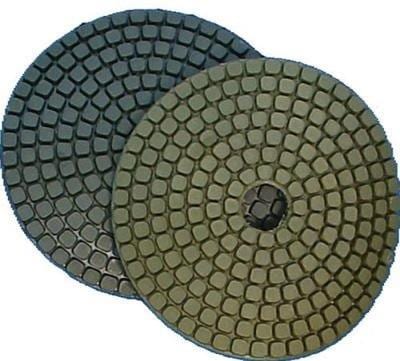
Stadea 4″ Wet/Dry Diamond Polishing Pads (8-Piece Set)
Complete 50-3000 grit resin-bond set for granite, marble, and engineered stone. 4″ diameter, hook-and-loop backed. Wet or dry rated (always wet for granite).
Typical price: $40-80. Check current price on Amazon →
Pros: Complete grit set in one purchase. Fits standard 4” backer pads. Good pad life per dollar. Well-reviewed by fabricators.
Cons: Wet-only for granite (manufacturer rates wet/dry but dry on granite damages finish). Backer pad sold separately on some retailers.
Rigid Floor-Format Pads
For large granite installations (commercial floors, heritage building restoration). Rigid pads match specific grinder-head formats (17”, 20”, 27”). Much higher cost per pad but 10-20× the coverage rate of hand-polishing.
Use case: stone floor restoration, commercial granite entry floors, granite fountain or sculpture work. Almost never used for countertops.
Metal-Bond Pads (Regrinding Only)
For granite that’s been damaged — deep scratches, etching, or dulling from years of use. Metal-bond pads in 30-200 grit remove material aggressively to flatten damaged surface. After regrinding, transition to resin-bond for polish progression.
Use case: restoration work, repair of damaged granite, or flattening a rough-quarried surface. Not needed for new fabrication work (most granite arrives factory-polished and only needs edge polishing).
Grinder Requirements
Polishing granite requires a variable-speed wet-capable grinder or dedicated granite polisher.
Why Variable Speed Matters
- Coarse grits (50-200): run 1,500-2,500 RPM. Higher speed burns the pad and heats the stone.
- Medium grits (400-800): run 2,500-3,500 RPM. The sweet spot for polish development.
- Fine grits (1,500-3,000): run 3,000-4,500 RPM. Higher speed produces better gloss on fine grit.
A fixed-speed 10,000+ RPM grinder runs too fast for every granite grit. Using one will burn coarse pads quickly and produce poor finish on fine grits.
Grinder Options
- Makita PW5001C ($400-550) — pro-grade granite polisher, variable speed 2,000-4,500 RPM, wet-rated with water feed port
- DeWalt DWP849X ($200-280) — variable speed 1,000-3,000 RPM. Not wet-rated out of the box; requires a GFCI and external water delivery
- Husqvarna PG 450 — dedicated concrete/stone polisher for floor-format work
Technique for Mirror-Finish Granite
Set Up Water Flow First
Water must be flowing before the pad contacts the stone. Dry startup scorches the pad. Use a continuous water feed or an assistant with a water bottle drip system.
Start Slow, Stay Slow on Coarse Grits
First pass at 50 grit should feel smooth and controlled. If the grinder is skipping or jumping, slow down. Coarse pads cut fast — force is not needed.
Don’t Skip Grits
Each grit removes the previous grit’s scratches and leaves its own, finer scratches. Skipping 400 grit leaves 200-grit scratches that 800 can only partially remove. The result: a hazy finish that looks “almost mirror” but never quite right.
Inspect Between Grits
After each grit, wipe the surface dry with a microfiber cloth and inspect at a low angle. Residual scratches from the previous grit are visible as fine parallel lines. Go back a grit if you see them.
Apply Sealer After Final Grit
A penetrating granite sealer fills microscopic pores and enhances the polish reflection. Apply after the 3000-grit pass is fully dry (30-60 min depending on humidity). Use a food-safe sealer for kitchen counters. Re-seal every 1-3 years.
Common Problems and Fixes
Hazy Finish After 3000 Grit
Usually a skipped grit or insufficient water flow. Go back to 400 or 800 and re-polish the affected area, then progress again through each grit.
Pad Wears Out Too Fast
Feed rate too fast, pressure too high, or wrong grinder speed. On coarse grits especially, let the pad cut — don’t push hard.
Scratches Visible After Polishing
Bond too hard (pad not granite-rated) or you’re using a concrete pad on granite. Use pads labeled for natural stone or granite specifically.
Burn Marks on the Stone
Dry polishing or insufficient water flow. Wet-polish only. If burn marks appear during normal wet polishing, water isn’t reaching the pad-stone interface — check the water feed.
Recommended Pads
POLISHSURF 11+1 Diamond Polishing Pad Set with Backer Pad
Full 50-3000 grit progression plus buffer pad, backing pad, and guide. 4″ hook-and-loop, resin-bond, wet or dry. Starter-to-pro kit for granite, marble, or engineered stone.
Typical price: $30-55. Check current price on Amazon →
Related Workflows
Polishing is the final step in granite finishing. Upstream workflows:
- Cutting granite — see Best Diamond Blades for Natural Stone
- Polishing concrete (related but different) — see Best Polishing Pads for Concrete
- Grit progression science (applies to granite too) — see Concrete Polishing Grit Progression Guide
For the full pad buying framework, see Polishing Pad Buying Guide.
Virginia Abrasives Note
Virginia Abrasives does not manufacture polishing pads — the VA lineup focuses on diamond blades and grinding cup wheels for concrete and masonry. We recommend Stadea and POLISHSURF for polishing work based on professional use and independent reviews. For concrete blades and grinding tools to pair with stone work, see the VA Amazon store.
Amazon Associate disclosure: we earn from qualifying purchases at no extra cost to you.
Frequently Asked Questions
What grit pads do I need for polishing granite? ▼
The standard granite polishing progression is 50, 100, 200, 400, 800, 1500, and 3000 grit. Seven steps for full mirror finish. For a satin finish, stop at 800 or 1500. Skipping grits leaves scratches the finer pads cannot remove. Always wet-polish granite — dry generates heat that can crack the stone.
Can I use concrete polishing pads on granite? ▼
Not reliably. Concrete polishing pads use a harder bond optimized for concrete's mid-range hardness. Granite is significantly harder, so concrete pads glaze on it — the bond doesn't erode fast enough to expose new diamonds. Use pads specifically rated for natural stone or granite for proper self-sharpening.
How do I get a mirror finish on granite? ▼
Work through every grit step without skipping. Use adequate water flow. Variable-speed grinder (slower on coarse, faster on fine). The 3000-grit pass produces a visible mirror-like reflection. Apply a penetrating granite sealer after the final pass to enhance and protect the shine.
How many pads do I need for a granite countertop? ▼
A single 30-square-foot countertop job uses about 1/4 to 1/2 of each pad in the 50-3000 grit set. A complete 7-pad set handles 2-3 countertop jobs of that size. For larger jobs or commercial floor work, calculate 3,000-6,000 square feet per pad depending on grit and concrete hardness.
Can I polish granite with an angle grinder? ▼
Yes, with a variable-speed wet-capable grinder (Makita PW5001C, DeWalt DWP849X, or similar) and a 4-inch polishing pad backer. Variable speed is critical — fixed-speed grinders run too fast for coarse grits and too slow for fine grits. Wet polishing requires a GFCI-protected outlet.
What's the difference between resin-bond and metal-bond pads for granite? ▼
Metal-bond pads are for aggressive grinding in the 30-200 grit range — typically used only if the granite needs re-grinding (deep scratches or surface damage). Resin-bond pads are for polishing in the 50-3000 grit range — the standard for granite polish work. Most granite jobs use resin-bond only.
Should I apply a sealer after polishing granite? ▼
Yes. A penetrating granite sealer fills the microscopic pores in the stone, protects against staining, and enhances the polish reflection. Apply after the 3000-grit pass is fully dry. Re-seal every 1-3 years depending on use. For kitchen counters, use a food-safe granite sealer.
Related Guides
- Best Diamond Blades for Natural Stone— Best diamond blades for granite, marble, limestone, sandstone, and slate. Bond-m…
- Best Diamond Polishing Pads for Concrete— Best diamond polishing pads for concrete floors and countertops — metal and resi…
- Concrete Polishing Grit Progression Guide— Concrete polishing grit progression: step-by-step sequence from 50-grit metal bo…
- How to Polish Concrete Floors— How to polish concrete floors — equipment, grit progression, densifier applicati…
- Diamond Polishing Pads: The Complete Buying Guide— Diamond polishing pad buying guide: wet vs dry polishing, grit progression from …
Shop Virginia Abrasives on Amazon
Diamond blades, cut-off wheels, and grinding tools, sold on Amazon.
Browse Products →