Best Diamond Blades for Pavers
Matt Lipman is CEO of Capstone Holdings Corp. (NASDAQ: CAPS) and a board member of Virginia Abrasives. He discloses this relationship for full transparency in our reviews.
⚡ Top Picks at a Glance
| Pick | Product | Best For | Rating | Price | Buy |
|---|---|---|---|---|---|
| Editor's Pick |  | Concrete + brick pavers on 14" chop saw or handheld cut-off saw. | ★ 4.2 (10) | $69.99 | Amazon → |
| Best Value |  | Smaller paver work on 9" angle grinder or cordless cut-off saw. | — | $55.66 | Amazon → |
Virginia Abrasives
VA 14" Ultra Value Diamond BladeConcrete + brick pavers on 14" chop saw or handheld cut-off saw.
Read our review →★ 4.2 (10)
$69.99
Buy on Amazon → Virginia Abrasives
VA 9" Ultra Value Diamond BladeSmaller paver work on 9" angle grinder or cordless cut-off saw.
Read our review →$55.66
Buy on Amazon →Verified Amazon listings. Prices update from Amazon at scrape time. We earn a small commission on qualifying purchases — see our disclosure.
Table of Contents
- The Short Answer
- Top Picks at a Glance
- How We Picked
- Why Pavers Need Material-Specific Blades
- Concrete Pavers
- Clay Pavers and Brick
- Natural Stone Pavers
- Porcelain Pavers
- Best Diamond Blades for Pavers: By Material
- Concrete Pavers
- Clay Pavers and Brick
- Natural Stone Pavers
- Porcelain Pavers
- By Tool: Table Saw vs. Tile Saw vs. Angle Grinder
- Masonry Table Saws (14” or 20”)
- Wet Tile Saws (7” or 10”)
- 14” Handheld Cut-Off Saws
- Angle Grinders (4.5” or 7”)
- Technique for Clean Paver Cuts
- Score First, Then Cut Through
- Cut Face-Up on Table Saws
- Cut Face-Down on Wet Tile Saws
- Use Water on All but Grinders
- Support Both Sides of the Cut
- Common Problems and Fixes
- Chipped Visible Face
- Blade Wears Too Fast
- Blade Glazes
- Irregular or Chipped Cut Edge
- Recommended Blades for Paver Cutting
- Related Material Guides
The best diamond blades for pavers depend entirely on the paver material — concrete, clay, natural stone, or porcelain each need a different blade. A universal “paver blade” doesn’t exist — using the wrong blade chips edges, burns through segments, or produces unusable cuts. This guide covers picks per material and tool type, with specs, pros/cons, and the technique that produces clean cuts for visible hardscape work.
The Short Answer
For most hardscape contractors cutting pavers:
- Best for concrete pavers (most common) — Virginia Abrasives 14″ Ultra Value ($69.99). Segmented, medium bond, fits masonry table saws and 14” cut-off saws.
- Best for clay pavers and brick — VA 14″ BD Asphalt/Green Concrete (about $63). Hard bond handles the abrasive wear of clay.
- Best for field cuts on any paver — VA 9″ Ultra Value ($55.66). Fits 9” grinders and cordless cut-off saws for on-site trim cuts.
- Best for natural stone pavers — a stone-rated blade matched to the stone. Our natural stone guide links the MK-215GL for granite and the MK-215 for marble.
- Best for porcelain pavers — a continuous-rim wet blade on a tile saw. See our porcelain tile guide for picks.
Top Picks at a Glance
| Paver Type | Best Blade | Bond | Rim | Price Range |
|---|---|---|---|---|
| Concrete pavers | VA 14″ Ultra Value | Medium | Segmented | $69.99 |
| Clay pavers, brick | VA 14″ BD Asphalt/Green | Hard | Segmented | $63.38 |
| Granite pavers | MK-215GL | Soft | Continuous | $49-140 by diameter |
| Limestone, sandstone | VA Ultra Value or BD line | Medium-hard | Segmented | $50-85 |
| Porcelain pavers | Continuous-rim porcelain blade (wet) | Very soft | Continuous | See porcelain guide |
| Field trim (grinder) | VA 9″ Ultra Value | Medium | Segmented | $55.66 |
How We Picked
Every blade here is rated for the paver material it’s matched to. We ranked on what can be checked without running the blades: the paver material each blade is rated for, rim type (continuous or turbo for a clean visible face, segmented for speed), fit, price, and availability. We have not run these ourselves and publish no measured figure for edge quality or blade life. Virginia Abrasives leads the concrete and abrasive-paver recommendations because its blades are Amazon-buyable, publish the specifications we compare on, and carry the relationship disclosed on this page; we have not run them ourselves. For porcelain and granite pavers, specialty blades from other makers are the right tool, and we name them without a performance claim.
Why Pavers Need Material-Specific Blades
Pavers come in four main categories, each with different cutting requirements:
Concrete Pavers
Mid-range hardness, moderately abrasive, contain aggregate (limestone or granite chips). Behave like cured concrete. A general-purpose segmented blade with medium bond handles them cleanly.
Clay Pavers and Brick
High silica content makes them extremely abrasive — they chew through soft bonds quickly. Need a hard-bond blade (similar to asphalt blade formulation) to resist premature wear. Historic brick may have inconsistent composition — test-cut a scrap before committing.
Natural Stone Pavers
Huge variation by stone type:
- Granite: very hard, non-abrasive → soft-bond continuous rim
- Sandstone: soft, highly abrasive → hard-bond segmented
- Limestone: medium hardness, medium abrasion → medium-bond segmented or turbo
- Bluestone: medium-hard → medium-bond turbo for chip-free edges
Match bond to stone hardness in reverse — harder stone, softer bond.
Porcelain Pavers
Extremely hard and dense — the hardest paver type on the market. Prone to edge chipping. Require continuous-rim wet-cut blades with soft bonds. Never attempt porcelain pavers with segmented blades or dry cutting.
Slurry note. Wet cutting pavers on a masonry table saw or wet tile saw produces 20-50 gallons of high-pH (12-13) cement slurry on a typical hardscape job — a prohibited non-stormwater discharge under EPA’s NPDES Construction General Permit. Don’t drain the saw reservoir into the lawn, the street gutter, or any storm drain. Vacuum recovery, filter berm, or solidifier are the standard options. Full details in Wet vs Dry Cutting Concrete.
For underlying blade-to-material science, see Diamond Blade Buying Guide.
Best Diamond Blades for Pavers: By Material
Concrete Pavers
The most common paver type for residential and commercial hardscape. Pedestrian pavers (thin) and vehicular pavers (thick) cut similarly — same blade, different feed rate.
Virginia Abrasives 14″ Ultra Value Diamond Blade
14″ × .125″ × 1″/20mm segmented rim, medium bond, wet or dry rated, 5,500 max RPM. Fits masonry table saws and handheld cut-off saws. Standard for concrete paver work.
★★★★☆ 4.2 (10 ratings on Amazon)
$69.99
Buy on Amazon →Pros: Good cut quality on concrete pavers. Fits every 14” masonry saw and cut-off saw. Wet or dry rated.
Cons: Segmented rim leaves slightly rougher edges than turbo — for high-end visible paver work, step up to a turbo rim blade.
Clay Pavers and Brick
Clay pavers are highly abrasive and burn through standard concrete blades quickly. Use a hard-bond blade formulated for soft, abrasive materials (same bond logic as asphalt blades).
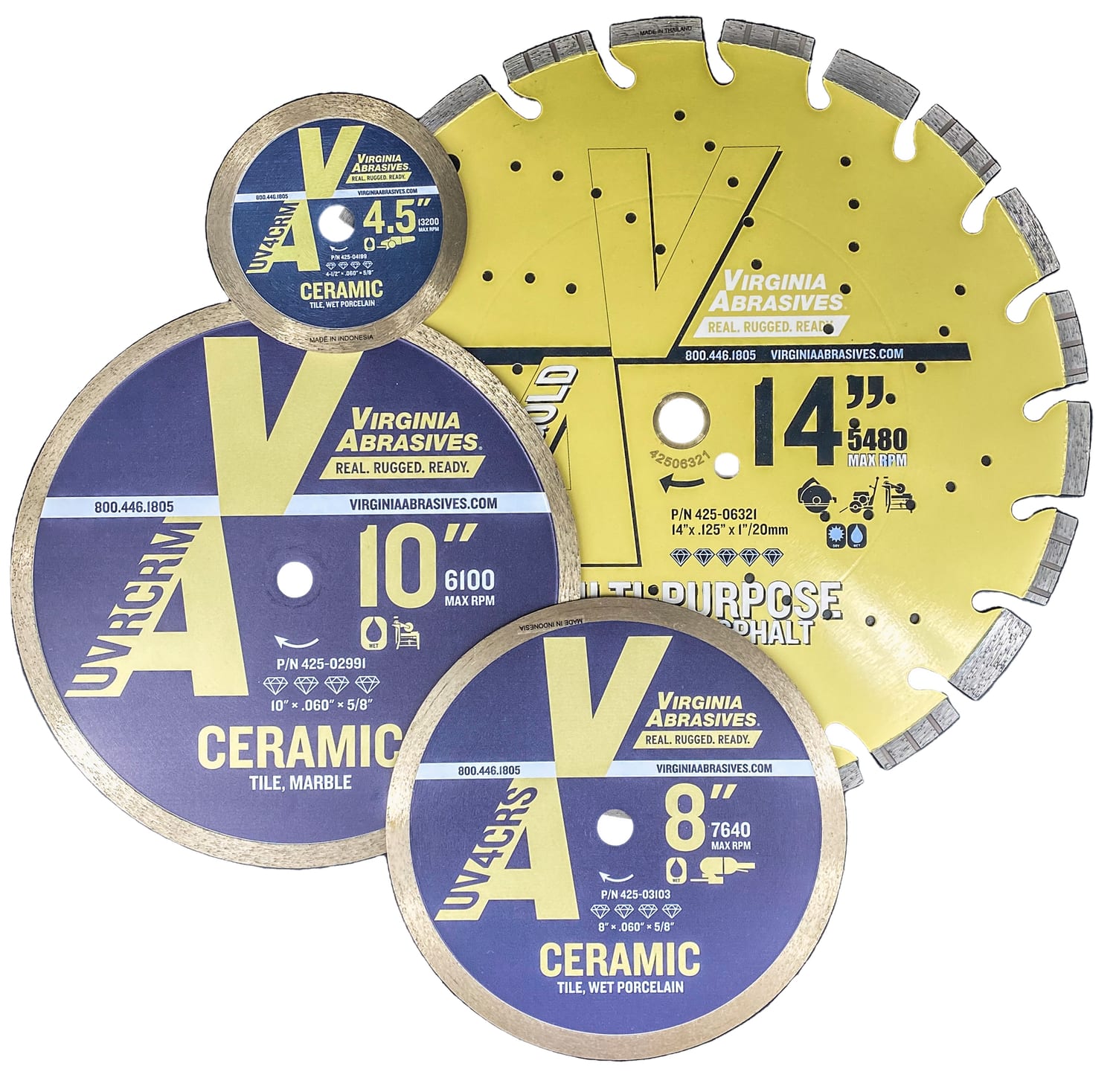
Virginia Abrasives 14″ BD Asphalt / Green Concrete Blade
Hard-bond segmented blade with wide gullets. Formulated for abrasive materials (asphalt, green concrete) — the hard bond resists clay paver abrasion. 14″ × 1″ arbor with 20mm bushing.
Typical price: about $63. Check current price on Amazon →
Pros: Resists premature wear on abrasive clay. Wider gullets flush fine clay dust. Same blade works for asphalt and green concrete (carry one blade for multiple materials).
Cons: Hard bond wears slowly on cured concrete — don’t use this blade on concrete pavers (it’ll glaze). Strictly for clay, brick, asphalt, and abrasive materials.
Natural Stone Pavers
Bond-matching varies by stone. Common paver stones:
- Granite pavers: MK-215GL continuous-rim wet-cut. Always wet.
- Sandstone and limestone pavers: VA Ultra Value or BD line, segmented, can be dry or wet.
- Bluestone: a turbo-rim blade rated for stone, for cleaner edges.
For detailed natural stone picks, see Best Diamond Blades for Natural Stone.
Porcelain Pavers
Specialty material. Requires continuous-rim wet-cut blades with soft bonds. Dry cutting and segmented blades both produce chipped edges on porcelain pavers.
We do not name a porcelain pick on this page; the porcelain tile guide below covers the blades we could check.
For detailed porcelain picks and technique, see Best Diamond Blades for Porcelain Tile.
By Tool: Table Saw vs. Tile Saw vs. Angle Grinder
Masonry Table Saws (14” or 20”)
The high-volume paver-cutting standard. Water-fed, bench-mounted, precision guide fence. Run wet for best cut quality and blade life.
Blade options: VA 14” Ultra Value for concrete pavers; VA 14” BD for clay pavers; a stone-rated blade for natural stone.
Pros: Precision cuts, fastest production rate, cleanest visible edges.
Cons: Fixed-location. Setup time for water and slurry. Capital cost.
Wet Tile Saws (7” or 10”)
Used for porcelain pavers, natural stone pavers, and smaller format pieces. Water reservoir integrated, linear guide.
Blade options: a continuous-rim porcelain blade for porcelain pavers; the MK-215 for marble pavers; the MK-215GL for granite pavers.
Pros: Clean cuts on delicate materials. Portable (though usually set up on a work bench).
Cons: Limited to smaller paver sizes. Slower than dedicated masonry saws.
14” Handheld Cut-Off Saws
For field cuts, large pavers that don’t fit on a table saw, or irregular cuts. Stihl TS 420, Husqvarna K 770, etc.
Blade options: Same 14” blades as masonry table saws. Ultra Value, BD, Sparkie depending on material.
Pros: Handles any size paver. Portable.
Cons: Less precise than table saws. Usually dry-cut (some support wet).
Angle Grinders (4.5” or 7”)
For field trim cuts, small adjustments, fitting around drains or obstacles.
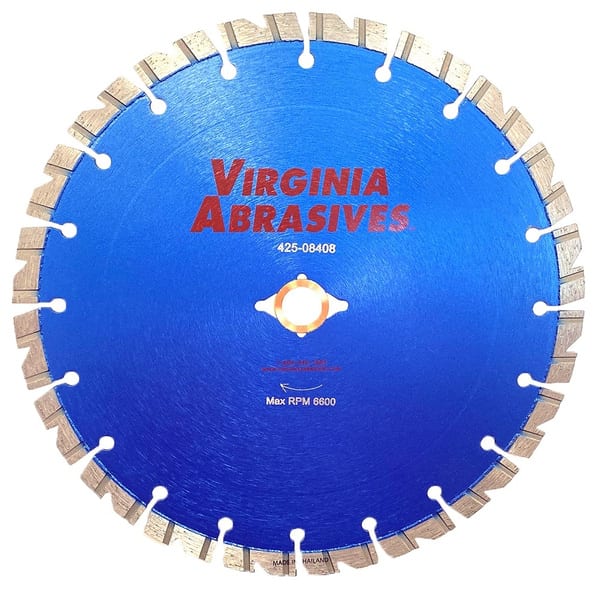
Virginia Abrasives 9″ Ultra Value Diamond Blade
9″ segmented blade for cordless cut-off saws and 9″ grinders. Field trim cuts on concrete and clay pavers. Same medium bond as the 14″ Ultra Value.
Typical price: $55.66. Check current price on Amazon →
Technique for Clean Paver Cuts
Score First, Then Cut Through
A shallow 1/8” scoring pass on the visible face creates a guide channel that minimizes chipping. Chipping happens where the blade exits the material, so after scoring, run the cut so the blade exits on the hidden side — which face that is depends on your saw (see the two sections below).
Cut Face-Up on Table Saws
On a masonry table saw, the blade cuts downward through the top of the paver. Place the paver face-up so chipping occurs on the back (hidden) side. The visible face stays clean.
Cut Face-Down on Wet Tile Saws
Wet tile saws typically cut upward from underneath. Place the paver face-down so chipping occurs on the back. Opposite of table saws — check the blade direction on your specific saw.
Use Water on All but Grinders
Wet cutting reduces chipping by 50-70% on brittle paver materials (porcelain, clay, natural stone). Concrete pavers tolerate dry cutting but still cut cleaner wet. Angle grinders are dry-only for electrical safety.
Support Both Sides of the Cut
Unsupported paver sections flex during the cut, causing chipping or breaking. Support thin pavers (less than 1.5” thick) on both sides of the cut line.
Common Problems and Fixes
Chipped Visible Face
Cutting face-down (cut face-up on table saws). Dry cutting on brittle material (use wet). Segmented blade on porcelain (use continuous rim). Feed rate too fast.
Blade Wears Too Fast
Wrong bond for material — soft bond on clay, hard bond on granite. Match bond to material hardness in reverse.
Blade Glazes
Bond too hard for material. Medium-bond blades glaze on granite pavers; hard-bond blades glaze on cured concrete. Match bond to material.
Irregular or Chipped Cut Edge
Workpiece not supported. Paver flexed during the cut. Feed rate inconsistent. Blade has segment damage (retire the blade).
Recommended Blades for Paver Cutting
| Blade | Best For | Link |
|---|---|---|
| VA 14″ Ultra Value | Concrete pavers, general masonry | Amazon |
| VA 14″ BD Asphalt/Green | Clay pavers, brick | Amazon |
| VA 9″ Ultra Value | Field trim cuts on pavers | Amazon |
| MK Diamond MK-215GL | Granite pavers, 10″ wet saw | Amazon |
Browse the full Virginia Abrasives lineup on Amazon →
Related Material Guides
- Best Diamond Blades for Concrete — full concrete blade coverage
- Best Diamond Blades for Block & CMU — related masonry work
- Best Diamond Blades for Natural Stone — stone pavers
- Best Diamond Blades for Porcelain Tile — porcelain pavers
For the full blade-selection framework, see Diamond Blade Buying Guide. For rim-type decisions, see Segmented vs. Continuous vs. Turbo. For blade life data, see Diamond Blade Lifespan Guide.
Frequently Asked Questions
What diamond blade is best for cutting pavers? ▼
For concrete pavers, a general-purpose segmented blade with a medium bond — the VA 14" Ultra Value covers this well. For clay pavers (abrasive), use a hard-bond blade. For natural stone pavers, match bond to stone hardness. For porcelain pavers, use a continuous-rim wet-cut blade.
Can I cut pavers with an angle grinder? ▼
Yes. A 4.5-inch or 7-inch diamond blade on an angle grinder handles most paver cutting. Use a segmented blade for fastest rough cuts or a turbo blade for cleaner edges. For large-format or porcelain pavers, a wet tile saw produces better results than an angle grinder.
Should I wet cut pavers? ▼
Wet cutting produces cleaner edges and controls dust. For masonry table saws and wet tile saws, always cut wet. A standard electric angle grinder must stay dry because of the shock risk; never use water with a grinder unless it is explicitly wet-rated. On a crew job, OSHA treats a grinder fitted with a cutting blade as a handheld power saw, and Table 1 lists water to the blade as the only control, so a dry grinder cut needs an exposure assessment, not just a respirator.
What size blade for a paver table saw? ▼
Most masonry paver table saws take 14-inch or 20-inch blades with a 1-inch arbor. Small tile-saw-style setups use 7-inch or 10-inch blades with a 5/8-inch arbor. Check the saw spec before ordering — wet tile saws often can't accept 14-inch blades.
How long does a paver blade last? ▼
As a planning estimate, not a measurement, a mid-range 14-inch segmented blade gives 150-300 linear feet of cuts on concrete pavers wet, or 80-150 feet dry. Clay pavers wear blades 30-50% faster due to abrasiveness. Hard aggregate in concrete pavers (granite chips, quartz) also shortens blade life.
Can I cut porcelain pavers with a regular blade? ▼
No. Porcelain pavers are extremely hard and chip-prone. They require a continuous-rim blade with a soft bond and fine diamond grit, used wet. A standard concrete blade chips the edges and wears fast. See Best Diamond Blades for Porcelain Tile for porcelain-specific picks.
What's the best blade for clay pavers? ▼
Clay pavers are highly abrasive — they wear soft bonds quickly. Use a hard-bond segmented blade (similar to asphalt blades). The VA 14" BD Asphalt/Green Concrete works well on clay pavers because it's formulated for abrasive materials.
Related Guides
- Best Diamond Blades for Concrete— Best diamond blades for concrete sold on Amazon, with specs and per-foot math, p…
- Best Diamond Blades for Block & CMU— Best diamond blades for concrete block and CMU — segmented picks for cutting cin…
- Best Diamond Blades for Natural Stone— Best diamond blades for granite, marble, limestone, sandstone, and slate. Bond-m…
- Best Diamond Blades for Porcelain Tile— Best diamond blades for porcelain tile — continuous-rim wet-cut picks that elimi…
- Diamond Blades: The Complete Buying Guide— Complete diamond blade buying guide covering bond types, segment styles, sizes, …
- Diamond Blade Lifespan: How Long Should It Last?— How long do diamond blades last? Expected cutting feet by blade type, 5 factors …
- How to Cut Pavers for a Hardscape Install— Cut concrete pavers, brick pavers, and stone for hardscape — saw vs grinder vs s…
- Segmented vs Continuous vs Turbo Diamond Blades— Segmented vs continuous vs turbo diamond blades — when to use each rim type, cut…
Shop Virginia Abrasives on Amazon
Diamond blades, cut-off wheels, and grinding tools, sold on Amazon.
Browse Products →