Single Row vs Double Row vs Turbo Cup Wheels
Matt Lipman is CEO of Capstone Holdings Corp. (NASDAQ: CAPS) and a board member of Virginia Abrasives. He discloses this relationship for full transparency in our reviews.
Table of Contents
- The Short Answer
- Head-to-Head Comparison
- Single-Row Cup Wheels
- What They Are
- Best For
- Virginia Abrasives Single-Row Turbo Cup Wheel
- Pros and Cons
- Double-Row Cup Wheels
- What They Are
- Best For
- Virginia Abrasives Double-Row Cup Wheel
- Pros and Cons
- Turbo-Spiral (Continuous-Rim) Cup Wheels
- What They Are
- Best For
- Virginia Abrasives Turbo Cup Wheel (Spiral)
- Pros and Cons
- Which One Should You Buy?
- If You Buy One: Double-Row
- If You Buy Two: Add a Single-Row
- If You Buy Three: Add a Turbo-Spiral
- If You Do Heavy Coating Removal: Skip Diamond
- Common Problems
- Wheel Loads Up
- Wheel Cuts Too Rough
- Wheel Wobbles
- Segments Break Off
- Quick Reference
Single-row cup wheels cut fastest on cured concrete and thin coatings. Double-row cut fast enough for most prep work with a smoother finish. Turbo-spiral (continuous-rim) leaves the smoothest surface but cuts slowest. The segment pattern determines how aggressively the wheel removes material, how well it resists loading on sticky coatings, and what surface finish you get for the next step. This guide compares all three head-to-head with specs, product picks, and the decision framework.
The Short Answer
- Aggressive coating removal, thin-mil epoxy, paint, thinset → single-row cup wheel
- General surface prep, leveling, mixed work → double-row cup wheel
- Finish grinding before polishing or coating → turbo-spiral (continuous rim) cup wheel
- Thick industrial epoxy or mastic → step outside the diamond lineup entirely: PCD cup wheel
Head-to-Head Comparison
| Feature | Single-Row | Double-Row | Turbo-Spiral |
|---|---|---|---|
| Segment pattern | 1 ring, wide gaps | 2 staggered rings | Continuous spiral rim |
| Cut aggressiveness | Highest | Medium-high | Low |
| Finish quality | Rough | Medium | Smoothest |
| Loading resistance (sticky coatings) | Best | Fair | Poor |
| Vibration | Highest | Lowest | Low |
| Cut speed on cured concrete | Fast | Fast | Slower |
| Typical price | $30-55 | $35-60 | $40-70 |
| Typical life on concrete | ~50-80 sq ft | ~80-150 sq ft | ~100-200 sq ft |
Single-Row Cup Wheels
What They Are
One ring of diamond segments around the outer edge, with wide gaps between segments. The open pattern concentrates grinding force on fewer contact points and flushes debris out through the gaps.
Best For
- Aggressive coating removal (paint, thinset, mastic, adhesive)
- Leveling obvious high spots
- Rough demolition grinding where finish doesn’t matter
- Any material where loading is a concern (sticky materials)
Virginia Abrasives Single-Row Turbo Cup Wheel
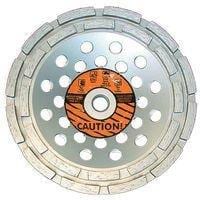
Virginia Abrasives Single-Row Turbo Cup Wheel
4.5″ single-row diamond cup wheel with wide segment gaps. 5/8″-11 threaded arbor, 13,300 max RPM. Best for aggressive coating removal on cured concrete.
Typical price: $30-55. Check current price on Amazon →
Pros and Cons
Pros: Fastest material removal of the three diamond patterns. Wide gaps prevent loading on sticky materials. Good debris clearance.
Cons: Roughest finish — not suitable as a final pass before coating or polishing. Highest vibration — harder on wrists over long sessions. Shorter blade life per square foot because fewer segments spread the wear.
Double-Row Cup Wheels
What They Are
Two concentric rings of segments in a staggered pattern. More total segments in contact with the surface means smoother finish, less vibration, and longer blade life — at the cost of slightly slower cut and worse loading resistance on sticky materials.
Best For
- General surface prep for overlays and coatings
- Leveling slab high spots
- Mixed masonry grinding (block, concrete, thin coatings)
- Contractors who want one cup wheel that handles most jobs
Virginia Abrasives Double-Row Cup Wheel
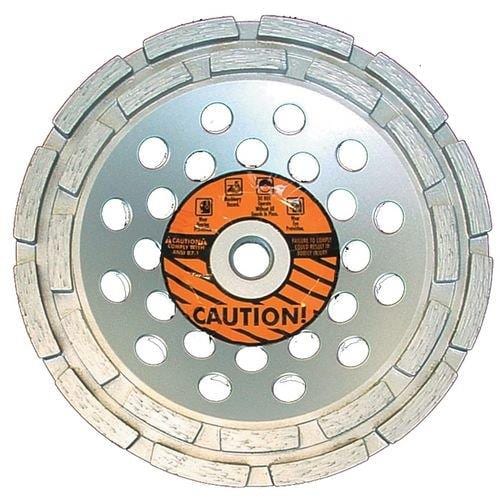
Virginia Abrasives Double-Row Diamond Cup Wheel
4.5″ double-row with 12-14 staggered diamond segments. 5/8″-11 threaded arbor, 13,300 max RPM. The most versatile cup wheel for general concrete prep.
Typical price: $35-60. Check current price on Amazon →
Pros and Cons
Pros: Best all-around pick. Good balance of cut speed and finish. Longer blade life than single-row (more segments spread the wear). Lower vibration — easier on the operator over long shifts.
Cons: Loads faster than single-row on sticky coatings. Not as fast on aggressive material removal. Not as smooth as turbo-spiral for finish grinding.
Turbo-Spiral (Continuous-Rim) Cup Wheels
What They Are
A true continuous spiral rim of diamonds with no gaps between segments. The spiral geometry rotates diamond contact around the surface, producing the smoothest finish of any cup wheel type.
(Note: some manufacturers label angled or wavy segmented wheels “turbo” as well. Those are transitional — between double-row and true continuous. The continuous-rim spiral is the smoothest. Check the product photo before ordering if finish matters.)
Best For
- Final pass before diamond polishing pad progression
- Surface prep before thin-mil coatings where surface profile matters
- Smoothing cured concrete that’s been roughly ground with a double-row
Virginia Abrasives Turbo Cup Wheel (Spiral)
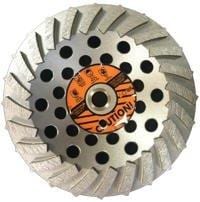
Virginia Abrasives Turbo Cup Wheel (Spiral Rim)
4.5″ continuous spiral diamond rim. 5/8″-11 threaded arbor, 13,300 max RPM. Final-pass cup wheel for prep before polishing or coating application.
Typical price: $40-70. Check current price on Amazon →
Pros and Cons
Pros: Smoothest finish of the three. Ideal transition from grinding to polishing. Longest wheel life on pure-concrete work.
Cons: Slowest material removal. Loads badly on sticky coatings — don’t use on fresh mastic. Overkill if the finish is a coating (a double-row produces adequate profile).
Which One Should You Buy?
If You Buy One: Double-Row
Handles 80% of contractor concrete prep work. Good finish, acceptable cut speed, reasonable loading resistance. The default recommendation for any contractor buying their first cup wheel.
If You Buy Two: Add a Single-Row
Covers the coating-removal use case that double-row handles poorly. Single-row plus double-row gets you through any job shy of thick industrial epoxy.
If You Buy Three: Add a Turbo-Spiral
Completes the lineup for contractors who grind-to-polish or grind-to-coating. Most contractors don’t need a turbo-spiral unless they do polishing progression or high-performance coating work.
If You Do Heavy Coating Removal: Skip Diamond
For thick epoxy, mastic, or industrial coatings, even a single-row diamond cup wheel loads and stalls. Use a PCD cup wheel — polycrystalline diamond segments cut 3-5× faster on thick coatings and resist loading completely.
Common Problems
Wheel Loads Up
Wrong pattern for the material. Double-row or turbo on sticky coatings load quickly. Switch to single-row for paint, thinset, mastic. Switch to PCD for thick epoxy.
Wheel Cuts Too Rough
Wrong pattern for the finish requirement. Single-row leaves visible grooves. Step down to double-row for general finish or turbo-spiral for polish-ready finish.
Wheel Wobbles
Flange problem, not a pattern problem. Check the grinder’s spindle nut and flange — all cup wheel patterns wobble if the mount is loose or flanges are worn.
Segments Break Off
Over-speed (RPM above the wheel’s rating), dropping the wheel, or sustained heavy loading. Cup wheels with missing segments are unsafe — retire immediately.
Quick Reference
| If you need to… | Use… |
|---|---|
| Remove paint or thinset fast | Single-row |
| Prep for thin-mil coating | Double-row |
| Prep for polishing progression | Turbo-spiral |
| Remove thick epoxy or mastic | PCD cup wheel |
| Level a concrete high spot | Double-row or single-row |
| Grind decorative stone edges | Turbo-spiral |
For product recommendations, see Best Grinding Cup Wheels for Concrete. For the full buying framework, see Grinding Cup Wheel Buying Guide. For thick-coating removal, see Best PCD Grinding Cup Wheels.
Browse the full Virginia Abrasives cup wheel lineup on Amazon →
Frequently Asked Questions
Which cup wheel pattern is most aggressive? ▼
Single-row cup wheels remove material fastest on cured concrete and thin coatings because the wider gaps between segments concentrate grinding force and resist loading. Double-row is the middle tier; turbo-spiral is the smoothest and slowest. For the most aggressive coating removal, step up to a PCD cup wheel.
What cup wheel leaves the smoothest finish? ▼
Turbo cup wheels with a continuous spiral rim produce the smoothest finish — ideal as a final pass before polishing progression or coating application. Double-row is the next-smoothest. Single-row leaves the roughest surface of the three.
Can I use a turbo cup wheel for polishing prep? ▼
Yes. A turbo spiral cup wheel is the standard final-grinding step before starting a diamond polishing pad progression. It leaves a smooth, scratch-minimized surface that 50-grit metal-bond polishing pads can immediately pick up without removing extra material.
Which pattern loads up least on sticky coatings? ▼
Single-row wheels have the widest gaps between segments, so they resist loading on sticky materials like fresh mastic, thinset, or soft epoxy better than double-row or turbo patterns. For very thick or stubborn coatings, a PCD cup wheel loads less than any diamond pattern.
Is turbo the same as a continuous-rim wheel? ▼
Not exactly. Traditional turbo cup wheels have angled or wavy segmented patterns with small gaps. Modern 'turbo spiral' cup wheels have a true continuous spiral rim with no gaps — smoother finish, slower cut, best as a final-pass wheel. Both sometimes get called 'turbo,' so check the product photos before ordering.
Which one should I buy first? ▼
For a contractor buying one cup wheel, a double-row gives the best balance of aggressive cut speed and acceptable finish for most concrete prep work. Add a single-row if you do coating removal regularly, and a turbo-spiral if you finish-grind before polishing or coating application.
Related Guides
- Best Grinding Cup Wheels for Concrete— Best diamond grinding cup wheels for concrete — single-row, double-row, turbo, a…
- Best PCD Grinding Cup Wheels for Coating Removal— Best PCD grinding cup wheels for removing thick epoxy, mastic, adhesive, paint, …
- Grinding Cup Wheels: The Complete Buying Guide— Diamond grinding cup wheel buying guide: segment patterns, bond hardness, and pi…
- How to Grind a Concrete Floor— How to grind a concrete floor — equipment selection, diamond tooling, dust contr…
- Silica Dust Safety for Concrete Cutting Pros— OSHA silica dust standards for concrete cutting. Table 1 compliance, dust contro…
Shop Virginia Abrasives on Amazon
Diamond blades, cut-off wheels, and grinding tools, sold on Amazon.
Browse Products →