Grinding Concrete With an Angle Grinder
Matt Lipman is CEO of Capstone Holdings Corp. (NASDAQ: CAPS) and a board member of Virginia Abrasives. He discloses this relationship for full transparency in our reviews.
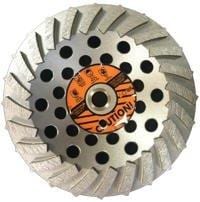
Table of Contents
- The Short Answer
- When to Use an Angle Grinder vs a Walk-Behind
- Cup Wheel Selection by Job
- Tools You Need
- Step-by-Step: Grinding Concrete with an Angle Grinder
- Step 1 — Set Up Dust Control First
- Step 2 — Mount and Inspect the Cup Wheel
- Step 3 — Test on a Hidden Area
- Step 4 — Work in Overlapping Passes
- Step 5 — Inspect and Re-Pass
- Common Mistakes
- Cost and Time Expectations
- OSHA Compliance and Silica Safety
- Related: Cutting vs Grinding
Grinding concrete with an angle grinder requires a diamond cup wheel, a dust shroud connected to a HEPA-rated vacuum, and steady overlapping passes — never a standard grinding disc. Use a single-row cup wheel for paint and coating removal, a double-row or turbo for general leveling and surface prep, and a PCD cup wheel for thick industrial coatings. Plan for 100-200 sq ft per day on a 4.5” grinder; past 200 sq ft, rent a walk-behind. Dry-grind only, and wear the respirator Table 1 lists for your location and hours.
The rest of this guide covers when an angle grinder is the right tool, how to pick a cup wheel, and the step-by-step technique that produces a flat surface without ruining the floor.
The Short Answer
For contractors and serious DIYers grinding concrete with a 4.5” or 7” angle grinder:
- Use a diamond cup wheel — single-row for coating removal, double-row or turbo for surface prep, PCD for thick epoxy or mastic. See Best Grinding Cup Wheels for Concrete.
- Connect a dust shroud and HEPA vacuum. Mandatory for OSHA compliance and your lungs.
- Match grinder power to wheel size. 4.5” cup wheels need 10+ amps; 7” wheels need 13+ amps or a heavy cordless platform.
- Work in overlapping passes at a steady walking pace. Never dwell.
- Stop at 200 sq ft of total job size. Past that, a walk-behind planetary grinder is faster, flatter, and easier on your back.
When to Use an Angle Grinder vs a Walk-Behind
The angle grinder is the right tool for a specific set of jobs. Outside that range, you fight the tool.
| Job | Right Tool | Why |
|---|---|---|
| Bathroom or closet floor (under 50 sq ft) | 4.5” or 7” angle grinder | Walk-behind won’t fit; angle grinder gets into corners |
| Garage floor edges and tight spots | Angle grinder | Walk-behinds leave a 2-3” perimeter the head can’t reach |
| Spot-leveling high lippage between pours | Angle grinder | Targeted stock removal on a small area |
| Removing paint or thin coating, under 200 sq ft | Angle grinder + single-row cup | Fast enough at this scale |
| Surface prep before epoxy, full garage (400-600 sq ft) | Walk-behind planetary grinder | 5-10x faster, flatter result, better dust capture |
| Polishing prep at 30-50 grit, full room | Walk-behind | Angle grinders cannot maintain consistent grit-by-grit progression on large areas |
| Mastic or thick epoxy across a warehouse | Walk-behind with PCD heads | Angle grinder will burn out before you finish |
The framing contractors use: under 200 sq ft, the angle grinder beats rental setup time. Over 200 sq ft, a $200-400/day walk-behind rental beats your time on the angle grinder.
Cup Wheel Selection by Job
The segment pattern matters more than the brand. Soft material, hard segments. Hard coating, soft segments. Wrong pattern, wasted wheel.
| Cup Wheel Pattern | Best For | Avoid On |
|---|---|---|
| Single-row segmented | Paint, thinset, mastic, light coatings | Smooth-finish prep — leaves visible scoring |
| Double-row segmented | General leveling, bare-concrete prep | Thick coatings — segments load up |
| Turbo (continuous spiral) | Smooth finish before polish or coating | Aggressive coating removal — too slow |
| PCD (polycrystalline diamond) | Industrial epoxy, mastic, thick paint | Bare concrete — wastes the PCD; use diamond |
For the deep comparison, see Single Row vs Double Row vs Turbo Cup Wheels. For coating-specialist picks, see Best PCD Grinding Cup Wheels.
Picks by pattern, each checked on Amazon September 22, 2026. Virginia Abrasives does not list cup wheels on Amazon, so these are third-party. For general prep, a double-row cup wheel with 16 segments on a 5/8″-11 thread. For a smoother finish, a turbo cup wheel with 14 segments. For thick coatings, a PCD cup wheel built for epoxy, glue and mastic, at about $77. Single-row 4.5″ wheels are thinly stocked on Amazon and the listings rarely state the pattern, so we name no pick; the pattern comparison explains when a single row is worth hunting for. Confirm 4.5″ or 7″ to match your grinder, and the wheel’s max RPM against your grinder’s nameplate, before checkout. If your job includes cut lines as well as grinding, the product finder matches blade to saw and substrate.
Tools You Need
- Angle grinder. 4.5” minimum 10 amps corded (Makita GA4530R, DeWalt DWE402, Milwaukee M18 FUEL high-output). 7” minimum 13 amps (Makita 9557PB, DeWalt DWE4557).
- Diamond cup wheel matching the job (see selection table above). Verify the wheel’s max RPM exceeds the grinder’s no-load RPM. Most 4.5” cup wheels are rated 11,000-15,000 RPM; 4.5” grinders run 10,000-13,300 RPM. Safe.
- Dust shroud sized to your cup wheel diameter. Brands include Bosch, DeWalt, Dustless Tools, and Mr. Nozzle. Universal shrouds with adjustable diameter cover both 4.5” and 5” wheels.
- Dust extractor with a rated filter. Festool CT 26/36, Bosch VAC090A, DeWalt DWV012, Makita VC4710. OSHA Table 1 requires at least 25 cfm of airflow per inch of wheel diameter, a filter of 99% or greater efficiency, and a cyclonic pre-separator or filter-cleaning mechanism; a HEPA filter clears the efficiency bar. See Silica Dust Safety Guide.
- P100 respirator. Half-mask or full-face. The shroud-and-vacuum captures most dust; the respirator covers the rest.
- Eye and ear protection. Sealed safety glasses or goggles. 25 dB+ ear plugs or muffs.
- Knee pads if you’ll be on the floor for more than 30 minutes.
Step-by-Step: Grinding Concrete with an Angle Grinder
Step 1 — Set Up Dust Control First
Connect the dust shroud to the grinder, route the vacuum hose, and verify suction at the shroud port before you turn the grinder on. Dust control is not optional and not retrofittable mid-job. If the vacuum bag is over half full, swap it now. Restricted airflow can drop the extractor below the 25 cfm per inch of wheel diameter that Table 1 requires.
Step 2 — Mount and Inspect the Cup Wheel
Spin the wheel by hand before powering up. Check for cracks, missing segments, or off-balance wobble. Verify the arbor matches the grinder spindle (most cup wheels are 5/8”-11 threaded for direct mounting on standard angle grinders). Tighten by hand plus the spanner wrench — overtightening cracks the wheel hub.
Step 3 — Test on a Hidden Area
Before committing, run a 6-inch test pass in a closet, behind a door, or in a future-cabinet zone. Confirm the cup wheel cuts at the rate you expect, that dust capture is working, and that the surface profile matches what you need (smooth for coatings, slightly rough for epoxy bond).
Step 4 — Work in Overlapping Passes
Move at a steady walking pace. Overlap each pass 50% with the previous one. Hold the grinder flat to the floor — tilting concentrates wear on one side of the segments and produces grooves. Let the wheel do the work; pressing harder doesn’t grind faster, it glazes the wheel.
For coating removal, work in straight lines. For surface prep, cross-hatch (north-south then east-west) for an even profile.
Step 5 — Inspect and Re-Pass
After each section, kill the grinder and inspect. Run your hand across the surface — it should feel uniformly textured with no smooth spots (missed coverage) or low spots (over-grinding). For coating removal, look for any remaining film and target it with a second pass.
Common Mistakes
Skipping the dust shroud. One uncontrolled grinding session puts you and anyone else in the room over the OSHA action level for silica. This is the most common and most dangerous mistake.
Wrong cup wheel pattern. A double-row cup wheel on thick paint loads up and stops cutting. A single-row on smooth-finish prep leaves a rough surface that takes extra passes to clean up.
Underpowered grinder. A 7-amp DIY grinder on a 4.5” cup wheel bogs and overheats inside 10 minutes. Match power to job: 10+ amps for 4.5”, 13+ amps for 7”, or a high-output cordless platform.
Pressing too hard. Concrete grinding is about pass count, not pressure. Hard pressure glazes the wheel, burns the segments, and stalls the grinder.
Going too deep. Cup wheels are designed for 1/16 to 1/8 inch per pass. For 1/4 inch+ stock removal, switch to a scarifier or shot blaster — cup wheels aren’t bulk-removal tools.
No respirator past the Table 1 limit. Indoors or in an enclosed area, Table 1 requires APF 10 once grinding runs past four hours in a shift, even with the shroud and extractor running. A fit-tested half-face P100 meets it.
Cost and Time Expectations
| Job Size | Time on 4.5” Grinder | Time on 7” Grinder | Walk-Behind Rental Equivalent |
|---|---|---|---|
| 50 sq ft (closet) | 1-2 hours | 30-60 min | Not worth setting up |
| 100 sq ft (small room) | 2-4 hours | 1-2 hours | Borderline — call it |
| 200 sq ft | 4-6 hours | 2-3 hours | Walk-behind wins |
| 400+ sq ft | All day, sore back | Half day, sore back | Walk-behind wins by a lot |
A 4.5” double-row diamond cup wheel runs $35-60 and grinds 50-200 sq ft on coatings before it’s spent. A PCD cup wheel runs $90-180 and grinds 200-500 sq ft on thick coatings. Walk-behind rental is $200-400/day plus tooling.
OSHA Compliance and Silica Safety
29 CFR 1926.1153 (the silica rule) gives handheld grinding two Table 1 routes: water fed to the grinding surface, outdoors only, or a shroud with a dust collector that moves at least 25 cfm per inch of wheel diameter through a filter of 99% or greater efficiency, with a cyclonic pre-separator or filter-cleaning mechanism. Standard angle grinders are dry-only, so the practical route is the shroud and dust collector, plus an APF 10 respirator indoors once the work passes four hours in a shift.
The 8-hour permissible exposure limit (PEL) is 50 micrograms of respirable crystalline silica per cubic meter of air. The action level is 25 µg/m³; for employers who assess exposure instead of following Table 1, it decides how often monitoring must be repeated. Medical surveillance follows respirator use: the employer must offer it to anyone required to wear a respirator under the rule for 30 or more days a year. One uncontrolled hour of concrete grinding can put a worker over the PEL for the day. Treat dust control as the first step, not an afterthought. See Silica Dust Safety Guide.
Related: Cutting vs Grinding
Cutting and grinding concrete are different jobs with different tooling. For making a cut line through a slab, use a diamond cut-off blade and the cutting technique. For removing material across a surface, use a cup wheel and the technique above. The two procedures aren’t interchangeable — a cutting blade on a flat surface burns out fast; a cup wheel on a cut line wanders and produces a ragged edge.
For larger floor work, see How to Grind a Concrete Floor (walk-behind territory).
Frequently Asked Questions
What kind of disc do I need to grind concrete with an angle grinder? ▼
A diamond cup wheel — never a standard grinding disc. For paint and coating removal, use a single-row segmented cup wheel. For general leveling and surface prep, a double-row or turbo cup wheel. For thick industrial epoxy or mastic, step up to a PCD (polycrystalline diamond) cup wheel. Standard metal-grinding discs and flap wheels load up instantly on concrete and shatter.
Can you use a regular angle grinder to grind concrete? ▼
Yes — any 4.5" or 7" angle grinder rated 10+ amps (corded) or a high-output cordless platform handles concrete grinding when paired with a diamond cup wheel and dust shroud. The grinder itself doesn't need to be specialized; the cup wheel and dust extraction do all the work. Underpowered grinders below 7 amps bog down on concrete and overheat.
How much area can I grind with an angle grinder? ▼
Plan for around 100-200 square feet per day on first-pass coating removal with a 4.5" cup wheel and around 200-400 square feet on a 7" wheel. Past 200 square feet for any single job, rent a walk-behind planetary floor grinder — it covers the same area in a fraction of the time and produces a flatter surface. Angle grinders are for spot work, edges, and small rooms.
Do I need water when grinding concrete with an angle grinder? ▼
No. A standard angle grinder should grind dry only, because water on an electric grinder not rated for it is an electrocution hazard. Manage silica dust with a vacuum dust shroud and a dust extractor that meets Table 1. Wet-rated grinders exist but are specialty tools; verify the tool nameplate before introducing water.
What does OSHA require when grinding concrete? ▼
OSHA's silica standard, 29 CFR 1926.1153 Table 1, gives two routes for handheld grinding other than mortar removal. Outdoors, you can use a grinder with integrated water delivery that continuously feeds water to the grinding surface. Indoors or out, you can use a commercially available shroud and dust collection system, where the collector provides at least 25 cfm of airflow per inch of wheel diameter and has a filter of 99% or greater efficiency with a cyclonic pre-separator or filter-cleaning mechanism. A HEPA filter clears the efficiency bar. The water route needs no respirator. With the shroud route, no respirator is required outdoors; indoors or in an enclosed area, APF 10 is required once the task runs past four hours in a shift.
How deep can an angle grinder cup wheel grind? ▼
A single pass typically removes 1/16 to 1/8 inch of concrete or coating. For deeper removal (1/4 inch+), make multiple passes — but past 1/4 inch of total stock, switch to a scarifier or shot blaster. Cup wheels were not designed for heavy stock removal; they glaze and waste segments fast on aggressive bulk grinding.
Why is my cup wheel smoking and not cutting? ▼
Three causes — glazing, wrong segment pattern, or overheating from no dust extraction. Glazing happens when the diamonds smooth over and stop cutting; dress the wheel on a soft abrasive block to expose fresh diamonds. Wrong pattern: a double-row cup loads up on coatings (use single-row instead). Overheating: every pass without dust extraction sends temperature spikes through the segments and shortens wheel life.
Related Guides
- Best Grinding Cup Wheels for Concrete— Best diamond grinding cup wheels for concrete — single-row, double-row, turbo, a…
- Grinding Cup Wheels: The Complete Buying Guide— Diamond grinding cup wheel buying guide: segment patterns, bond hardness, and pi…
- How to Cut Concrete With an Angle Grinder— Pro guide to cutting concrete with a 4.5", 7", or 9" angle grinder — segmented d…
- How to Grind a Concrete Floor— How to grind a concrete floor — equipment selection, diamond tooling, dust contr…
- Silica Dust Safety for Concrete Cutting Pros— OSHA silica dust standards for concrete cutting. Table 1 compliance, dust contro…
- Single Row vs Double Row vs Turbo Cup Wheels— Single row vs double row vs turbo diamond cup wheels — aggressiveness, finish, l…
Shop Virginia Abrasives on Amazon
Diamond blades, cut-off wheels, and grinding tools, sold on Amazon.
Browse Products →